


My note earlier today embarrassingly stated that:
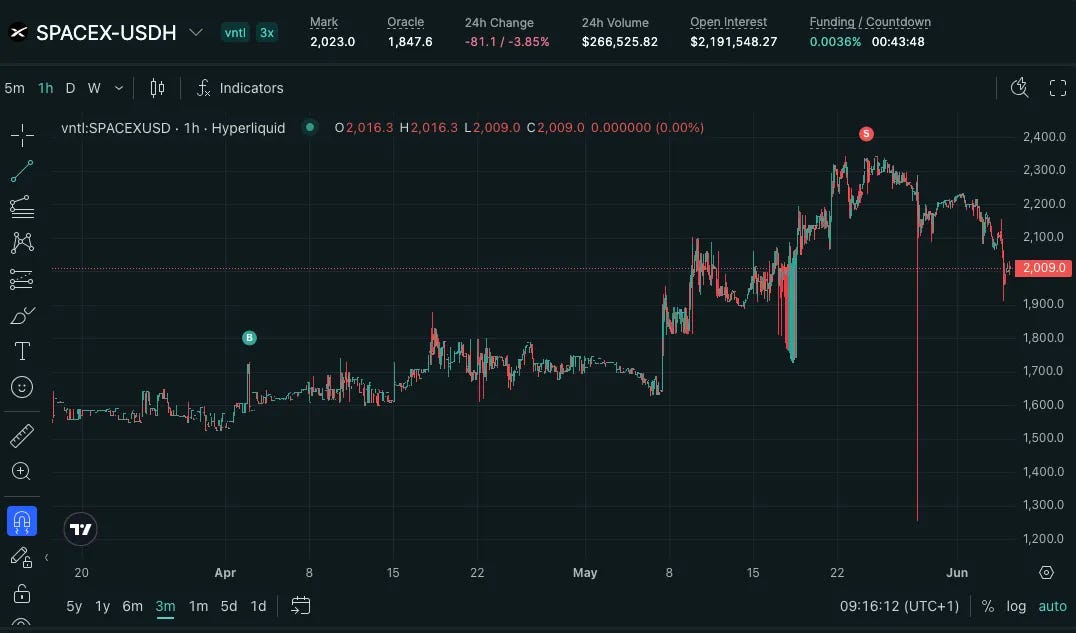
“What I can tell you about that experience. I bought about $45 bucks of SPCX perps on April 2 on a 2x leveraged basis ($101.94), entry at $1,699 per share. I cashed out on May 24 at $2,330. My position by that point was valued at $139.82, representing a profit of $37.77. That’s a 37.1 percent gain. Not bad not bad. And given the flash crash that occurred on May 28, a pretty lucky exit.”
Mea culpa, mea culpa. I wrote the above before going to bed while falling asleep and I don’t know what I was thinking. It’s obviously all wrong.
Since it is too painful to live with, I have to formally correct the record.
However, in the process of penning my correction, it’s also the case that I ended up taking a much closer look at how these markets actually work. And, in fairness, the exercise turned out to be rather illuminating. Because Pre-IPO perps don’t function like ordinary perps.
So if you're curious about the peculiarities of these instruments and why they’re very far from retail-investor friendly, read on. If you're only here for the corrected numbers, feel free to skip to the bottom.
Pre-IPO perps are fairly exotic instruments
It may come as a shock to readers, but the SpaceX perp market on Hyperliquid isn’t really a market in the conventional price-discovery sense.
More buyers in these markets do not automatically translate into higher valuations, because in perpetual futures markets, everything depends on daily funding rate adjustments.
As of May 17, Hyperliquid offers two ways to gain exposure to SpaceX. Both contracts feature their own unique peculiarities.
My trade was in the earlier-listed Ventuals contract, which — as you can see above — offers exposure to SpaceX’s total company value.
But the price action is no simple thing. At any given time, it reflects the interaction of three factors: 1) the traded market price 2) the oracle/reference valuation 3) the funding rate.
