


A week ago, Poland’s parliamentary Committee on Constitutional Accountability voted to recommend that central bank governor Adam Glapiński be brought before the State Tribunal, advancing an effort backed by Prime Minister Donald Tusk’s governing coalition to hold him accountable for alleged misconduct during his tenure.
The allegations include misleading the finance ministry about the National Bank of Poland’s 2023 profits and indirectly financing government deficits through bond purchases during the pandemic. Glapiński denies wrongdoing (and FWIW I think he makes a good case).
To the international observer, the saga probably looks like a bitter domestic political dispute of little global consequence. A petty parochial affair.
But investors really should pay attention. The consequences could have graver implications for international monetary stability and the geopolitical order than many appreciate.
To understand why these developments are potentially explosive, it’s necessary to run readers through the political backstory.
Poland is currently run by a centre-right ruling coalition led by Donald Tusk’s Civic Platform. The party gained power in 2023 on the explicit promise its leaders would conduct sweeping purges of the previous right-wing government, known as PiS (aka the Law and Justice party), across Polish institutions. PiS are best thought of as Poland’s equivalent of MAGA: nationalist capitalists who distrust both the EU and Russia. The Civic Platform, on the other hand, sees itself as a liberal force for good, and is closely aligned with the EU.
The two sides have been at war for a long time. Most of the time, the right wing accuses the “centrists” of being assets of foreign interests (Russia and Germany mostly), and the centrists accuse the right wing of (checks notes) being assets of the Russians. A key point of dispute concerns PIS’s historic reform of Poland’s courts, notably the Constitutional Tribunal, which the EU and international community deemed a breach of the rule of law, a fact that led to the freezing of billions of euros of EU payments as a penalty.
Mainstream coverage, however, often neglects the Court’s unique history.
The Tribunal was created in 1982 as a conciliatory gesture by the incumbent communist regime to address the rising political clout of Poland’s anti-communist Solidarity trade union. Just before communism fell, the communists used what power they still had to stack the court with lifetime appointees sympathetic to their regime and ongoing interests.
The idea that the court was never fully purged of communist influence underpins the right-wing claim that, by 2015, when PiS first gained power, the Court needed significant reform and lustration. The mechanics of how they achieved this and why their actions were dubbed “democratic backsliding” by the EU are explained here.
The communist legacy aspect, however, is rarely addressed in mainstream coverage, despite being central to the conservative diagnosis of what was wrong with the Polish state and the courts to begin with.
Indeed, everything makes considerably more sense when viewed not simply as a struggle between democracy and authoritarianism, but as a conflict between two different understandings of what happened when Poland emerged from communism in 1989.
One understanding, associated with the Tusk liberals (which includes Radosław Sikorski, aka Mr Anne Applebaum), regards the post-1989 constitutional settlement as a historic achievement: Poland established an independent judiciary, protected judges from political interference, and gradually consolidated democracy.
The other, associated with PiS and the wider Polish conservative tradition, sees the transition as fundamentally incomplete. Poland democratised its political institutions but allowed substantial continuity within the judiciary, bureaucracy, economic establishment and other institutions.
It’s worth emphasising that Poland’s communist regime did not collapse through a complete revolutionary replacement of its institutions.
Instead, the transition began with the 1989 Round Table negotiations between the communist authorities and the Solidarity opposition, producing a partially free election and a negotiated transfer of political power.
The settlement helped avoid political violence and enabled a relatively peaceful transition. But it also meant that much of the existing state apparatus remained in place. Indeed, former communist party members such as Aleksander Kwaśniewski and Leszek Miller were back in power within a few years.
This was particularly consequential for the judiciary.
Unlike a legislature, which can be replaced through elections, the judiciary depends on continuity, professional qualifications, security of tenure and protection from political removal. Those features are essential to judicial independence. They also make it difficult to replace an inherited judicial establishment, all the more so when former communists are still part of the political system.
Significantly, in the war between the two sides, the EU openly sided with the liberals.
The result saw Poland formally penalised by Brussels, with EU funds withheld as punishment. Poland was also formally accused of democratic backsliding and the breakdown of the rule of law.
Tusk’s appointment in 2023 led the EU to unlock some of these funds on the understanding his government would reconstitute the court’s independence.
Thus far, however, this has not happened because the right wing has maintained control of the Presidency and its veto power. It is also significant that the President, Karol Nawrocki, is on particularly good terms with Donald Trump.
Pathway to monetary chaos
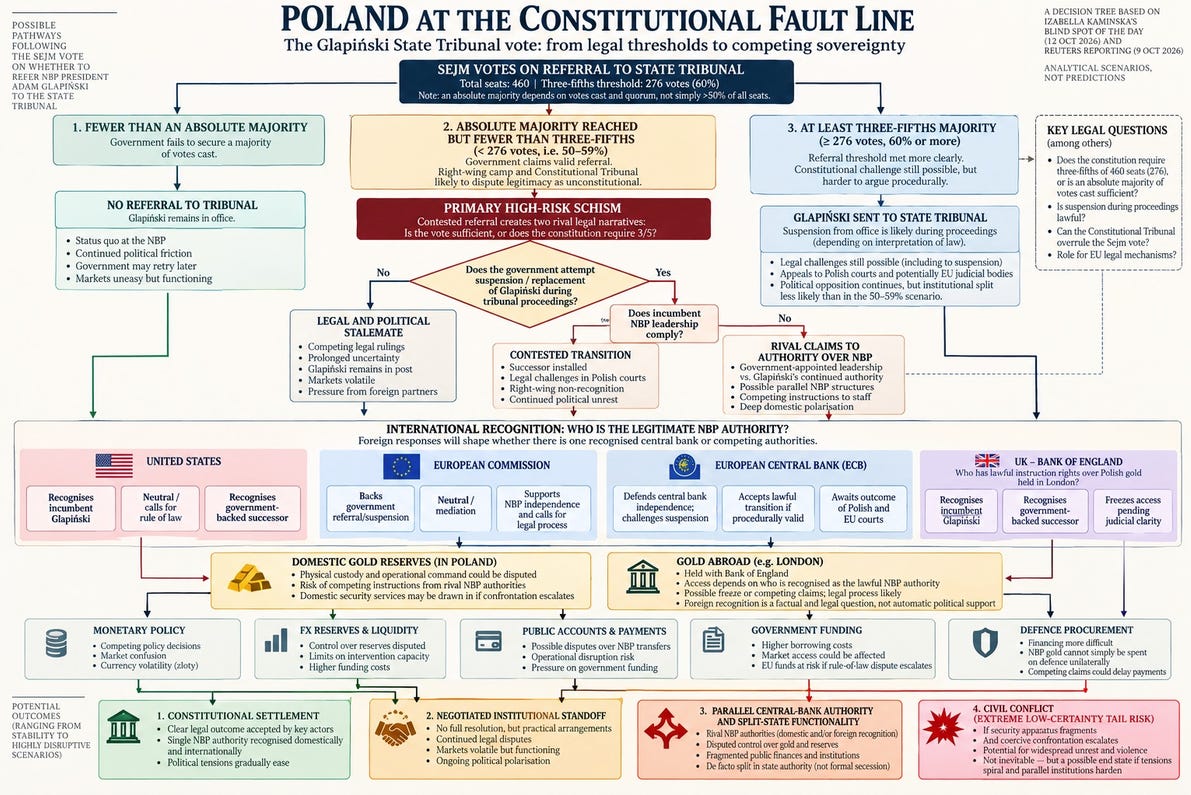
The governing coalition’s political pursuit of Glapiński comes in the context of this longstanding judicial dispute. But it is also directly impacted by it because the contested Court ruled in 2024 that any proceedings against the NBP governor require a three-fifths majority in the Sejm, rather than an ordinary absolute majority, to proceed. The Court also rejected the provision that would automatically suspend Glapinski upon his referral to the State Tribunal.
The numbers matter a lot. In a 460-seat parliament, three-fifths means 276 votes, while an absolute majority, assuming all members participate, means 231.
The governing coalition may therefore be able to assemble sufficient votes under one interpretation of the law but not the other.
The current parliamentary schedule indicates Glapinski is likely to face such a vote on November 5-6.
If the trial proceeds on an absolute majority basis, Glapiński could, in theory, argue that the referral is constitutionally invalid and that he remains entitled to exercise his powers at the NBP. However, the government could also maintain that the proceedings are lawful and that he should be suspended.
Most likely, neither side will recognise the other’s position.
That opens the door to Poland finding itself not only with a disputed central-bank governor but competing claims over the legal authority of the institution itself.
For a central bank, this is a particularly dangerous form of uncertainty. As we all know, monetary policy depends on the assumption that the authority issuing instructions is legally recognised and that its decisions can be implemented without challenge.
Once that assumption becomes contested, the dispute can travel beyond the domestic constitutional system.
The relevant questions cease to concern only whether Glapiński should remain in office. They begin to concern who can convene the Monetary Policy Council, who can authorise operations, who can move reserves, and whose instructions foreign financial institutions should accept.
The dates that matter
The first significant date is November 4.
That is when the term of Adam Lipiński, the NBP’s remaining deputy governor, is due to expire. Unless a new appointment is made, the central bank’s management board will fall from seven members to six, which is below the statutory minimum.
Under Article 17 of the NBP Act, the management board consists of the governor and between six and eight additional members.
The problem is not merely that the bank would have fewer senior officials. The law does not clearly establish the consequences of a board operating below its prescribed composition.
Moreover, the vacancies are not accidental. Appointments to the board have become part of the political confrontation, with Tusk rejecting candidates proposed by the bank until Nawrocki stops vetoing the government’s judicial appointments.
On the same day, the Monetary Policy Council is also scheduled to announce its next interest-rate decision.
And herein lies another problem. While the NBP management board is not responsible for conducting monetary policy decisions, it is responsible for implementing its resolutions and overseeing important operational functions.
For now, it is unclear to what degree the MPC may be stunted by Glapinski’s removal.
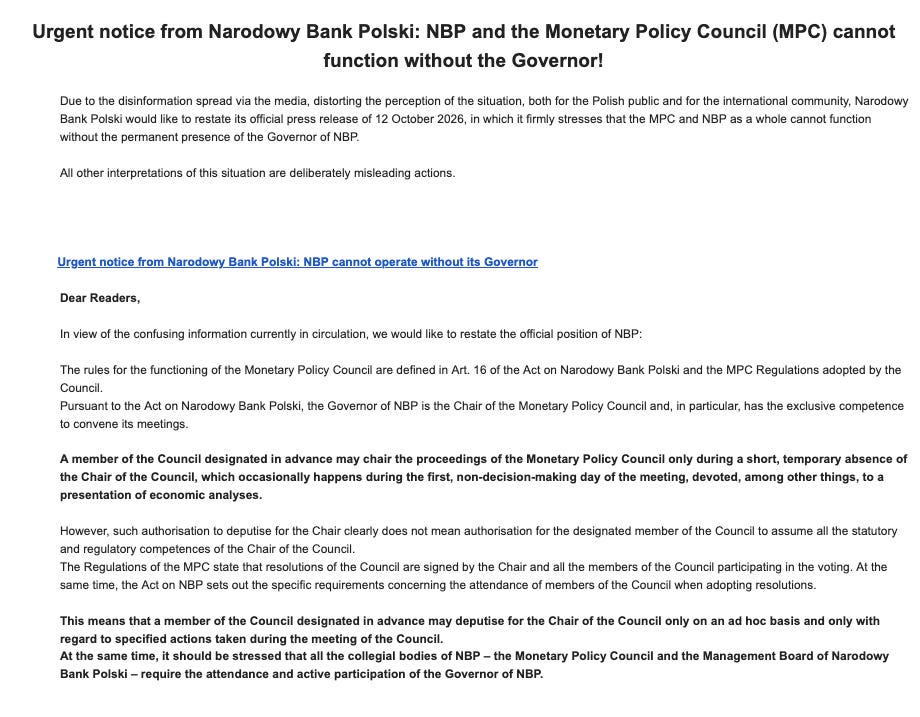
In a Bloomberg report published on October 10, Monetary Policy Council member Ludwik Kotecki said that the NBP would continue functioning without Glapiński. He also indicated that council members could make monetary-policy decisions using their own expertise and analysis, even without documentation from the management board.
However, Kotecki is not a neutral figure. He is an appointee of the ruling coalition and thus naturally aligned with the Tusk camp, not Glapinski.
Moreover, even if Poland’s ability to set interest rates is uninterrupted, the more difficult question concerns implementation of such policy, which still requires board approval.
For example, could a board operating below the statutory minimum validly approve an extraordinary liquidity measure? Could it authorise a significant intervention in foreign-exchange markets? Would counterparties accept its decisions without seeking additional legal assurances?
Given the Glapinski case is centred on claims he failed to follow due process, the optics of subsequently breaking the rules would not be great.
There is also a separate procedural question surrounding the Monetary Policy Council itself.
Kotecki warned that Glapiński’s suspension could complicate the convening of meetings. Although council member Ireneusz Dąbrowski has been designated to preside in his absence, the lack of a first deputy governor and the expiry of the second deputy governor’s term create uncertainties around the institutional arrangements for convening the council.
The third important period is the first part of November, when parliament could potentially consider the State Tribunal referral.
If the vote occurs after November 5-6, which will likely be the case, the NBP management board could already be below its statutory minimum. This could produce a contested suspension of the governor.
In that circumstance, the central bank would face two different problems simultaneously: uncertainty over the composition and powers of the body responsible for implementing monetary policy, and uncertainty over the identity of the person legally entitled to lead and represent the institution.
This would be unprecedented in the European monetary system.
What happens from here on is far more did difficult to predict. But here are some scenarios:
Scenario one: the constitutional dispute is contained
The least disruptive pathway is that Poland’s institutions find a way to avoid a direct confrontation.
For example, the government could agree to appointments that restore the NBP management board to its required composition, and Nawrocki could yield on Tribunal appointments. Alternatively, Parliament could delay the referral, fail to secure the necessary votes or proceed in a manner that does not produce an immediate suspension.
The legal consequences of a referral could also be clarified before they interfere with the bank’s operations.
In all these scenarios, the central bank could continue functioning at both the Monetary Policy Council and board level.
The political dispute would remain bitter, but the financial consequences would hopefully be limited.
While it’s important not to dismiss this outcome, I personally don’t think it’s very likely.
This week alone there were clashes between right-wing protestors who had forged a human ring around the Tribunal building and the police. This came after the government went ahead with swearing in a government-selected judge without Nawrocki’s approval:


Scenario two: Poland develops two competing interpretations of central-bank authority
The more consequential scenario begins with a parliamentary vote that the government considers sufficient to refer Glapiński to the State Tribunal but that Glapiński and his supporters regard as constitutionally defective.
The government could maintain that he has been suspended.
Glapiński could maintain that he remains governor.
The central bank might continue to operate through its existing staff and procedures, but decisions requiring new legal authorisation could become contested.
The immediate market reaction would depend on whether investors believed the dispute could be contained without impairing monetary operations. Polish bonds, however, are already the worst performing in the EU after France.
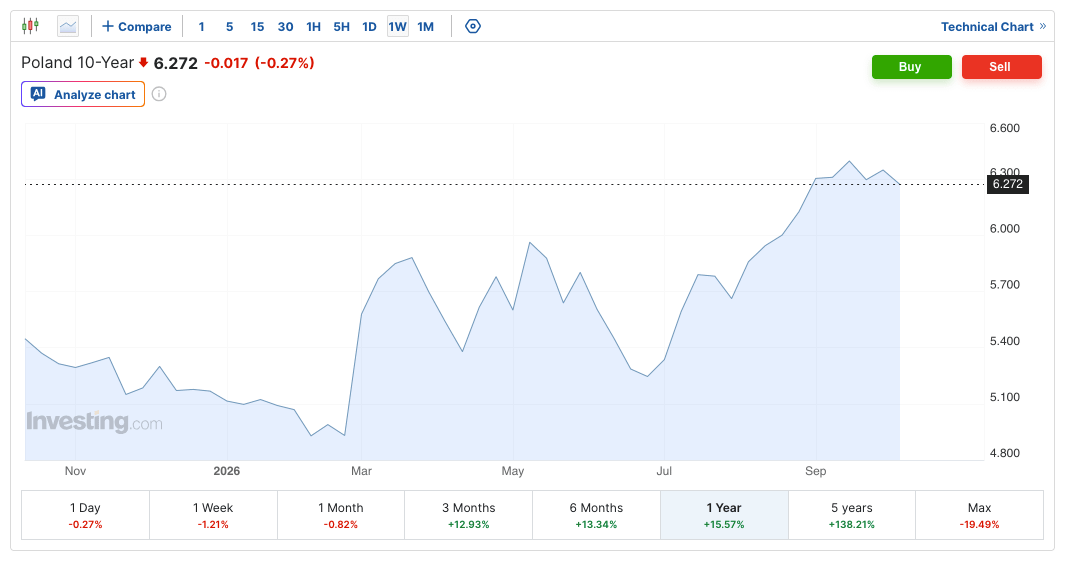
Nonetheless, if routine business continued, the initial consequences might be modest.
But the situation could become more serious if the NBP needed to undertake an exceptional operation.
Imagine, for example, that the zloty (already significantly depreciating) came under pressure while the bank’s management board remained below the statutory minimum.
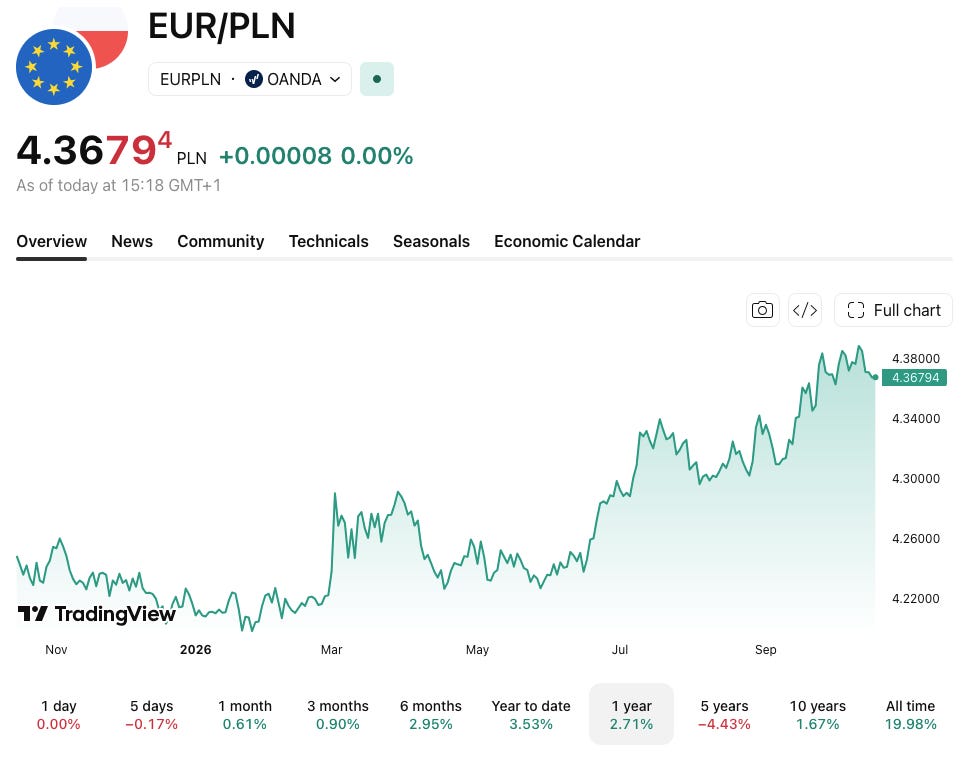
The Monetary Policy Council might agree that intervention was desirable. Yet questions could arise about whether the management board possessed the authority to approve the necessary transactions.
Now add a dispute over the governor’s status.
A foreign counterparty might receive instructions from an NBP official whose authority the government contests, or from an acting official whose authority Glapiński contests.
Would that counterparty execute the transaction?
Would it seek a legal opinion?
Would it wait for clarification from the Polish courts or European institutions? Nobody knows.
Scenario three: the ECB becomes the arbiter of Polish monetary legitimacy
At this point, the confrontation could move beyond Poland. While Poland is not a member of the euro area, the NBP does belong to the European System of Central Banks.
As it stands, the ECB has already warned about the implications of proceedings against Glapiński for central-bank independence.
Article 14.2 of the Statute of the European System of Central Banks and of the ECB establishes protections against arbitrary dismissal and provides a route for judicial review before the Court of Justice of the European Union. In theory, that means on the same basis that the ECB spoke out against Trump’s political pursuit of Jerome Powell, it would have to speak out in favour of Glapinski.
This could put it in a bit of a bind, since it would be openly going against the wishes of the EU.
Indeed, if the ECB defended Glapiński against a suspension it considered incompatible with European law, the Polish government could accuse it of interfering in a domestic constitutional process.
On the other hand, if it accepted a contested suspension without defending the relevant safeguards, this would undermine the principle of central-bank independence that underpins its own institutional legitimacy, not least because many of the things Glapinski is accused of also apply to other EU central bankers.
This could damage its credibility.
That is where the story begins to resemble situations Europeans generally assume cannot happen within the EU.
The Libya analogy: surely not in Europe?
Libya provides a useful historical analogy.
Following the collapse of the previous political order, competing centres of authority emerged, with disputes over the control and legitimacy of state institutions and financial resources.
The relevance is not that Poland is comparable to Libya in its political stability, institutional capacity or economic circumstances.
It is that competing claims to monetary authority create a problem that cannot always be resolved within the country concerned.
International counterparties must decide which authority they recognise.
A central bank can claim ownership of assets, but its ability to move those assets may depend on whether foreign custodians accept the instructions of the people claiming to represent it.
A country can possess monetary reserves without enjoying uncontested operational control over them.
For European policymakers, the assumption has long been that such questions belong to countries suffering state breakdown, civil conflict or international isolation.
But what if a major European economy found itself with a central-bank governor whose authority was recognised by some institutions but disputed by others?
The Venezuelan gold dispute offers another instructive precedent.
During the confrontation over the legitimacy of Venezuela’s government, access to bullion held at the Bank of England became entangled in British recognition policy and litigation over who was authorised to represent the Venezuelan central bank.
Given how much gold Poland has been buying of late, the custodian of this gold could end up with significant influence over how things evolve at the NBP. For the most part, Poland holds its gold in secret locations at home, but a significant chunk is also held in the BoE vaults too. The Venezuela precedent therefore is likely very relevant.
Why Europe’s wider financial position matters
The possibility of such a dispute arising within the EU would be troubling under any circumstances.
It is even more consequential when viewed against the deteriorating fiscal position of major euro-area economies, particularly France.
France’s public finances have become an increasingly important source of concern for investors and European policymakers.
The ECB must maintain monetary credibility across a currency union whose member states retain their own fiscal policies and whose governments face very different political constraints.
That makes the consistent application of monetary rules especially important.
If the ECB were drawn into a Polish constitutional confrontation, its actions would be judged not only against the legal protections for central-bank independence but also against its handling of political and fiscal pressures elsewhere in Europe.
A perception that Frankfurt was willing to take a forceful position against a Polish national institution while accommodating pressures from larger euro-area governments could become politically explosive.
The issue would be whether European monetary institutions were perceived as applying their principles consistently.
A Polish confrontation could therefore become a broader argument about the political foundations of the European monetary order.
At the same time, the geopolitical environment is becoming less predictable and Poland sits at the centre of many of these tensions.
It is an EU member state, a NATO member, a major actor on Europe’s eastern flank and a country that retains its own currency. It is also in talks with Donald Trump about the establishment of US bases on its territory.
That means, while its financial relationships are embedded in European institutions, its security relationships are deeply connected to Washington.
If a Polish constitutional dispute became a confrontation between national and European institutions, differences between American and European strategic priorities could affect the available pathways.
Scenario four: the ECB sides with the EU’s political institutions
The most politically consequential scenario for Europe would arise if the ECB recognised the position of the Tusk government and the EU’s political institutions over the competing claims of Glapiński and his supporters.
At this point, the precise legal circumstances would matter. A decision grounded in an authoritative court ruling is not the same thing as a discretionary political endorsement.
But perception still makes a difference.
If a substantial part of Poland’s political establishment came to believe that the ECB had subordinated central-bank independence to the preferences of Brussels or the governing coalition, the consequences could extend far beyond Glapiński’s tenure.
The principle at stake would be whether European monetary institutions protect national central banks from political interference or determine which domestic political authorities are entitled to control them.
For the ECB, the distinction would be crucial to its credibility.
Moreover, for Polish eurosceptics, an intervention perceived as political could provide a powerful argument against deeper monetary integration.
Poland is currently committed under its EU accession framework to eventual euro adoption, although it has no agreed timetable.
Until now, the debate over joining the euro has largely revolved around economic convergence, exchange-rate flexibility, monetary sovereignty and the costs and benefits of membership.
A confrontation over the NBP could introduce a different consideration.
Scenario five: a rupture in euro access, but not dollar access
The most extreme scenario begins with a prolonged breakdown in the relationship between a Glapiński-led NBP and European institutions.
Suppose Glapiński continued to assert his authority despite a contested suspension.
Suppose European institutions recognised a different leadership or imposed legal and operational constraints on dealings with the NBP officials they did not recognise.
And suppose the resulting confrontation impaired access to particular euro-denominated settlement or liquidity channels.
Would Poland necessarily lose access to the dollar system as well?
Not automatically.
The euro and dollar systems operate through different legal jurisdictions, institutions and correspondent networks.
This distinction becomes particularly important if Washington and Brussels approach the Polish confrontation differently.
For one, Poland is not in the euro area, and the NBP’s relationship with the Eurosystem is not equivalent to that of a euro-area national central bank.
Nor is access to TARGET services the same thing as the ability of Polish commercial banks to maintain euro correspondent accounts or conduct euro transactions through other intermediaries.
There is, as far as I know, no single ECB switch that can simply turn off every euro transaction involving Poland.
A serious restriction would have to arise through specific legal, regulatory, correspondent-banking or operational channels. But this would amount to declaring war on Poland.
It would be an extraordinary escalation, and one that would impose costs on European counterparties as well as Poland.
But let’s nonetheless imagine that certain euro channels became restricted or unreliable while dollar relationships remained available.
Polish institutions might then seek to reroute some international transactions through dollar correspondent banks, dollar-denominated funding markets or other instruments capable of transferring dollar claims.
That would create a remarkable asymmetry.
An EU member state could find itself relying more heavily on the dollar because of a breakdown in its relationship with parts of Europe’s own monetary infrastructure.
Such an outcome would have implications well beyond Poland. The optics would be terrible.
It would raise questions about the euro’s role as an international currency and the extent to which access to its infrastructure could become conditional on political or institutional recognition.
It could also create an opening for monetary arrangements that operate outside conventional euro settlement channels, such as, you’ve guessed it: stablecoins.
Gold-backed assets and liabilities
Finally, gold could provide another component of such an adaptation.
The NBP is well known to have accumulated substantial bullion reserves. In a severe confrontation over European monetary access, those reserves could acquire a different strategic significance.
One possibility would be to use gold as collateral for new forms of transferable liabilities.
These could be gold-denominated claims, dollar-denominated instruments backed by bullion, or hybrid arrangements combining gold collateral with digital settlement mechanisms.
Moreover, this isn’t as rogue an option as it might be in the US. Glapinski and Nawrocki have already publicly floated the idea of using unrealised gold profits to fund a separate “sovereign” defence programme focused on US arms procurement. This went nowhere because the plan required the government’s sign-off, which was not forthcoming. The Tusk government preferred to commit Poland to Europe’s SAFE programme, which is centred on buying EU arms.
A formal schism between the government and the President (who is officially commander of the military) could change those dynamics.
Concluding thought
Poland’s constitutional confrontation may ultimately be resolved without a serious interruption to the NBP’s operations.
The Sejm may not vote in the indicative November window. Appointments may restore the management board to its statutory composition. A legal or political accommodation may prevent a contested suspension.
But the underlying vulnerability is clearly already visible. It’s worth being prepared for anything, including the previously unthinkable.
The NBP’s view
Moments after posting the above I found the below in my inbox. The NBP clearly disagrees with Kotecki regarding the MPC’s potential capacity to continue operations without the Governor.
The polls for next year's ellections put the "sovereignist" opposition ahead of the present government. What would be the likelyhood that a changed Court, on the like of Tusk, would not enable a similar judicial coup d'etat like in Romania, in December 2024?
Given the standoff between the PM and the President over the last 48hrs over the Constitutional Court, does that skew the probabilities of each of the five scenarios somehow? Interested in hearing your thoughts