



With the digital euro still trundling through Brussels’ drawn-out legislative process, the risk is mounting that it will arrive too late to counter the surging wave of dollar-backed stablecoins that threaten to extend U.S. dominance into Europe’s payments system.
A group of European banks is confident it can move faster.
Operating under the name Qivalis, the 12-bank consortium — formally established in December 2025 — is aiming to bring a euro-denominated stablecoin to market as early as the second half of this year. If it delivers, that would put it years ahead of the ECB’s own timeline, which does not envisage a digital euro launch before 2029.
“If you want the euro to remain relevant in global finance, you need to bring it onto the infrastructure where value is increasingly moving,” Qivalis CEO Jan Sell told The Peg in an exclusive interview. “People are starting to realize blockchain rails are simply the more efficient rails for future payments and future movement of value. And if the euro is not represented there, then it will be the U.S. dollar.”
The group’s efforts to secure the euro’s place in the rapidly expanding stablecoin ecosystem have not gone unnoticed in Brussels.
Earlier this month, Qivalis was invited to brief the Eurogroup — an indication that both EU and ECB officials are increasingly recognising that the digital euro may not be sufficient to safeguard the eurosystem’s strategic autonomy amid a growing field of foreign blockchain-enabled competitors. The urgency is compounded by the rapid pace at which the stablecoin ecosystem continues to evolve.
The global stablecoin market reached $300 billion in March, yet euro-denominated stablecoins account for just €615 million in market capitalisation, according to ECB data — a fraction of their dollar-based peers.
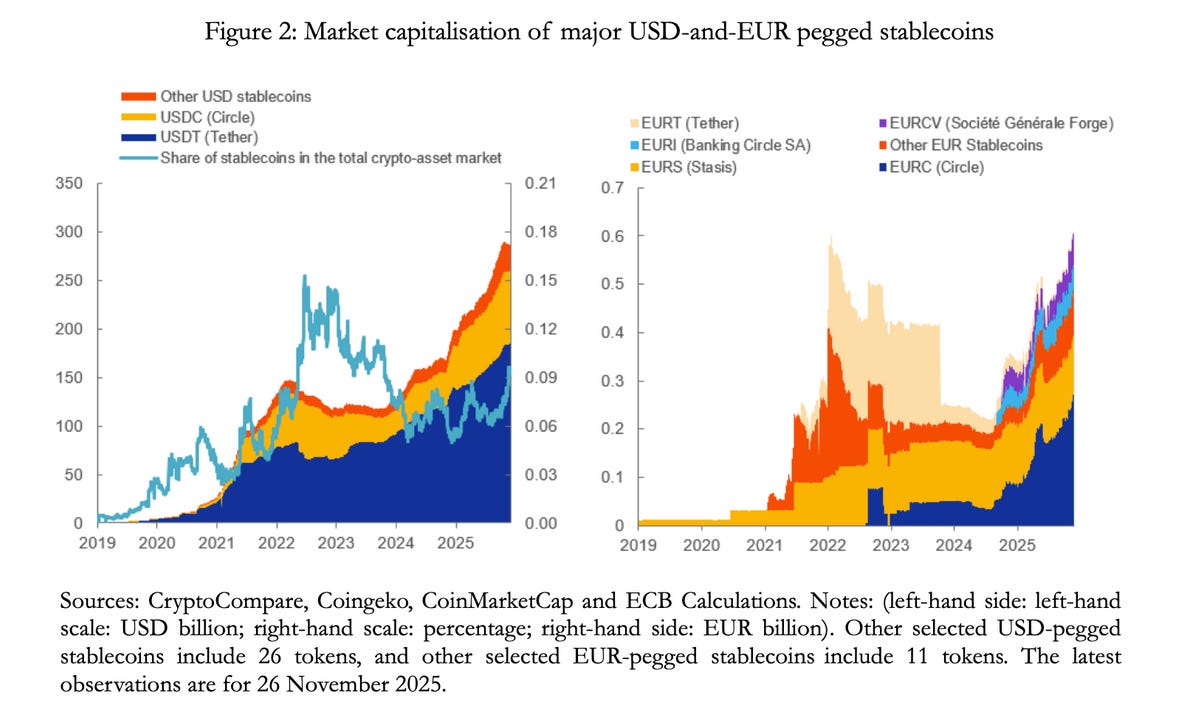
Against this backdrop, central bank officials — including Bundesbank boss Joachim Nagel — have become more open to supporting euro-denominated stablecoins, including, potentially, by granting them access to central bank settlement infrastructure, as is already being explored or implemented in other jurisdictions.
Some say the shift in mindset among policymakers speaks to a growing awareness that the continent’s dependence on foreign — largely U.S. — payment infrastructure risks Europe being cut off if relations between Brussels and Washington deteriorate further.
