Life is so cruel. I learned moments ago that Perry Mehrling, arguably the most astute monetary thinker of our time, passed away yesterday. I hear he suffered a head injury.
Frankly, I am at a loss for words. Perry wasn’t just a formidable monetary thinker, he was a uniquely kind and warm soul, who was always unbelievably generous with his thoughts and time. It’s why so many people considered him a mentor. I was privileged enough to hang out with him and to benefit from his insights.
In fact, he was the first person I properly geeked out with about the rise of stablecoins and the fact they were akin to the second coming of eurodollars.
The irony is I was planning on bigging him up in a post today, long before I heard about his passing.
This is because Inaki Aldasoro of the BIS coincidentally pubilshed an academic paper today drawing heavily on Perry’s work. It was flagged to me beforehand, so I had an inkling of what to expect.
And, of course, it hasn’t disappointed.
In honour of Perry, I am just going to present some key passages without comment, as they speak for themselves.
I already told Inaki I think this is the best paper on the nature of money that I’ve ever read. And not to diminish Inaki’s own contribution (as he too is a great thinker) but as his own footnote in the paper says:

So without further ado, here is arguably the best synthesis of the money view ever committed to a BIS portal (with my emphasis):
What makes banks special?
Banks occupy a unique position in the monetary system. They are not merely financial intermediaries that channel funds from savers to borrowers. They are issuers of liabilities that circulate as means of payment, and this distinguishes them from every other type of financial institution. The architecture described in the main text, of a hierarchy anchored by par and sustained by specific institutional arrangements, has a consequence that is worth making explicit, because it bears on how one thinks about the nature and design of money.
The distinction is a social fact, not merely a legal or regulatory one (and to be sure, these differ across countries and over time, an issue I abstract from). An economy’s allocation to bank-issued assets is not determined at the individual margin but by social norms and network effects (Sissoko (2025)). People hold transaction deposits first and foremost because deposits are what everyone else accepts in payment. Usage begets acceptance, acceptance begets wider usage, and the feedback loop delivers the scale that makes the modern payment system efficient.
A banking system can be seen as the institutionalisation of the naked shorting of the unit of account (Sissoko (2021)). A naked short creates a phantom supply of the shorted object that disappears when the short is closed out. Banks do precisely this when they accept private debt and issue their own liabilities in return: they create a phantom supply of the unit of account in the form of deposits, a supply that expands when loans are made and contracts when they are repaid. The metaphor is apt because it captures both the alchemy of banking (ie the ability to generate means of payment that did not previously exist) and its inherent fragility, since the phantom supply is sustainable only as long as confidence in the issuer holds and, critically, as long as the claims made today against an unknowable future are validated tomorrow.
If what makes banks special is this attribute of their liabilities, an important question follows: is the attribute confined to traditional deposits, or does it extend to other instruments? Much discussion in recent decades has centred on the rise of so-called market-based finance or shadow banking, and on the apparent disintermediation of traditional banks (Pozsar et al (2010); Adrian and Jones (2018)). From this paper’s perspective, banks have been disintermediated only nominally. What has happened is that the form of bank liabilities functioning as money has shifted, from traditional retail deposits into wholesale funding, off-balance sheet commitments and money-like instruments such as repo and commercial paper (Sissoko (2025)). Shadow banking, in this reading, is not the growth of a market-based alternative to banking. It is an extension of banking itself (Acharya et al (2024); Mehrling et al (2013)), a multiplication of the types of bank liabilities (and bank-adjacent liabilities) that the economy is willing to treat as money. Under this view, the structure of banking sector liabilities adjusts to meet the portfolio and liquidity preferences of the non-bank sector. These preferences are a function of many variables (including policy rates and returns on other assets, risk aversion, the general state of the economy, etc), and they can shift under stress – which is when the hierarchy of money is most useful for locating the pressure points. (These considerations are relevant of course for new, digitally driven forms of shadow banking.)
And the conclusion is fairly fantastic too:
This architecture – hierarchical money anchored by a central bank, elastic credit disciplined by funding, private initiative validated by public authority – was not designed from a blueprint. It evolved through centuries of experimentation, crisis and institutional adaptation, from the bill of exchange to the goldsmith’s note to the eurodollar. At each stage, private agents discovered new ways to create money-like claims; and at each stage, the authorities at the top of the hierarchy were eventually called upon to validate or reject the innovation. The pattern recurs because the underlying tension between the creation of private money and the need for public anchoring is part of the monetary system. The tension is never resolved; it is only managed.
The international dimension adds a further layer. Modern money is global money, and the tensions that the paper has traced domestically replicate at the global level, but with weaker institutions, asymmetric backstops and no global sovereign. The management of global money remains, in important respects, an unsolved problem.
Understanding this architecture is a precondition for evaluating any proposal to change it. New forms of money may promise programmability, speed or broader access. But unless they are denominated in the unit of account rather than merely priced against it, guarantee par through ultimate settlement in central bank money and provide (or are provided with) elastic liquidity backstopped by public authority, they risk reviving the frictions that the modern monetary system evolved to solve.
The appeal of gold and bitcoin, as assets that are no one’s liability, reflects a desire to exit the social compact that money embodies. But money without trust is a contradiction in terms. Stablecoins, for their part, are the latest instance of a private initiative creating promises to pay that aspires to be treated as money. Their success will depend not on the technology but on whether they are brought within the hierarchy and subjected to its disciplines. As always, the exorbitant privilege of money creation comes with commensurate responsibility.
I will revisit the section on stablecoins specifically in a separate post. For now, a moment’s silence for Perry…
I, like everyone else in the geeky monetary plumbing community, will miss you immensely.
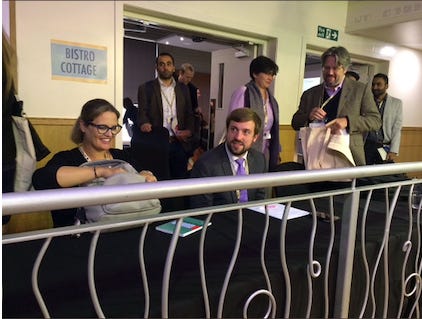
The photo below was taken on October 19, 2017, the day Perry and I first discussed the rise of stablecoins at a conference in Edinburgh: