


One of the more surprising findings buried in the Bank for International Settlements’ advance release of its stablecoin chapter from the upcoming 2026 Annual Economic Report concerns a question that central bankers rarely have to ask: what happens when the marginal dollar starts being priced somewhere other than the traditional banking system?
The issue emerges in the report’s discussion of monetary policy transmission.
Under the conventional monetary system, central banks influence economic activity largely by changing the price of money. Policy rate adjustments ripple through money markets, bank funding costs, deposit rates, lending rates and ultimately spending and investment decisions.
Stablecoins may not fit neatly into that framework.
The BIS notes that most stablecoins do not directly pay interest. At first glance, that might suggest they should be even more sensitive to changes in policy rates than bank deposits. When interest rates rise, holding a non-yielding stablecoin should become less attractive relative to other assets.
Yet the emergence of decentralised finance has complicated that picture.
Stablecoin holders increasingly have access to yields generated through lending pools and other crypto-native financial arrangements. Those yields can be substantial. More importantly, according to the BIS, they appear to be driven by forces almost entirely separate from the traditional financial system.
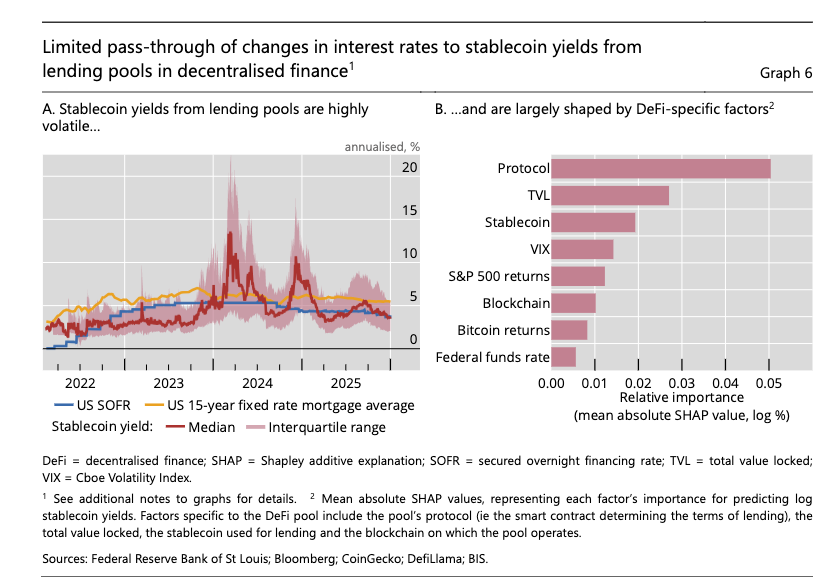
“The evolution of yields earned in lending pools, however, has remained largely disconnected from traditional US interest rates,” the report notes.
