Dear Peg subscribers and readers,
It is with a degree of reluctance that I find myself compelled to draw attention to a rather serious wrong that has, of late, afflicted the monetary world.
It is a wrong that bears significant systemic consequences for all of us, albeit mostly this publication.
It relates to the unfortunate usage of the term “pegging” by parties operating outside financial and monetary contexts. This “appropriation” is now giving rise to a degree of stigma, with negative digital externalities, for those of us who still primarily associate the term with its original financial usage.
I would respectfully remind readers that such usage — leaving aside carpentry, camping, and clothes-hanging — has a long-standing heritage dating back to at least the 1930s: a rightful original claim, if ever there was one.
This is why I have decided, as of this week, to launch an unofficial campaign to reappropriate the term for its proper monetary application.
Why now?
In what can only be described as a fairly profound display of innocence, when I decided to rebrand this publication The Peg from its original Cash Equivalence, I was not aware that the term had, in recent years, been repurposed to denote what might be described mildly as an expression of female empowerment.
I realised something wasn’t quite right while at lunch with a male bank equity analyst late last year, specifically when he began to chuckle awkwardly upon the reference.
I have since educated myself on the term’s “other” meaning, which (as far as I can tell) has a rather less illustrious pedigree, emerging only around 2001.
The proper financial usage, I should point out, was chiefly popularised in the aftermath of Bretton Woods, when the dollar was famously pegged to gold and other currencies to the dollar. This is why the name seemed a perfect fit for a publication focused not just on stablecoins, but on the broader rewiring of the global financial system.
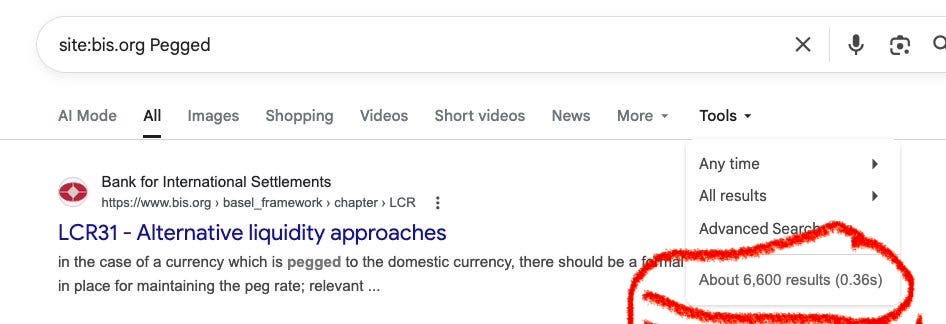
Central bank archives, I would stress, are jam-packed with pegging references — currencies pegged, rates pegged, regimes pegged, etc. Pegs everywhere.
Given this rather weighty heritage, it seemed difficult to justify retreat upon familiarisation with the more salacious application.
On reflection, in a supposedly female-empowered era, there was really only one option: lean into the faux pas. It is not the first time, after all, I’ve been caught out by my naivety (famous Virgin Atlantic story, IYKYK).
Moreover, as a long-time James Bond fan, I decided it was about time that the finance industry loosen its tie, ditch the stiff demeanour, and indulge in a bit of tongue-in-cheek humour like they used to in the good old eurodollar days.
Alas, the real trouble began when I set up my new email: izabella@thepeg.co
It turns out that corporate email filters, now the vigilant defenders of professional decorum in an increasingly no-fun-allowed environment, preemptively block even entirely respectable emails if they originate from an outfit called thepeg.co.
This is, understandably, a problem for a journalist who needs to engage in overt solicitation to land stories. For now, I have resorted to my other “safe for work” domain, the-blindspot.com (ironically named, given this story). But this is proving suboptimal.
This is why, after yet another pingback, I decided this week that something more proactive needs to be done.
Hence, the publicisation of my woeful plight in the hope of stimulating an organic, widespread reappropriation campaign — one that may yet compel corporate filters the world over to open up to The Peg.
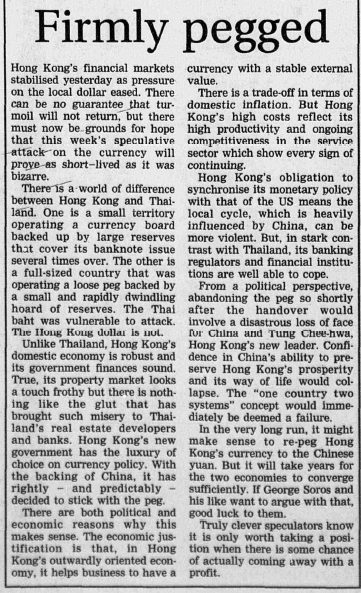
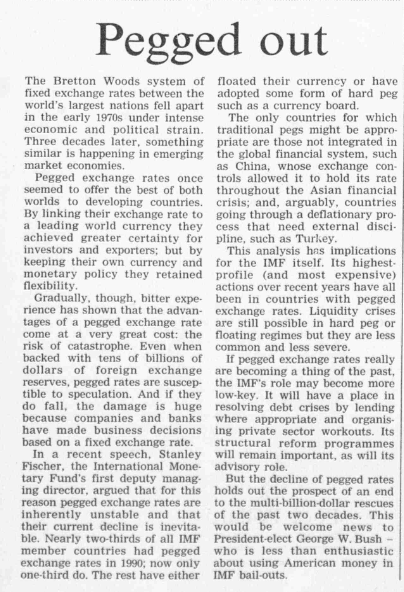
At this point, I would gently remind readers that it’s not just the most powerful central banks and publications in the world that boast ample references to pegging. There are 7,263 references to things being “pegged” in the Financial Times alone.

I attach pictorial evidence of this respectable historic usage, in the hope it might assist those wishing to lobby their IT systems administrators on my behalf that pegs should not, in fact, be blocked.
Thank you for your attention to this matter.
The destigmatisation of “pegging” is no laughing matter. We must work together to restore the term to its rightful place in monetary discourse.